Where are we now?

Where are we now?

Thursday, 17 March 2016

Into Cambodia

*** Fair warning - unpleasant images after the halfway point***

Next stop was Phnom Penh, Cambodia.  Cambodia is a place not short on issues, having spent the twentieth century being successively ruined by the French; the Americans/Vietnamese; a ridiculously diverse number of internal factions; and finally and more comprehensively destroyed by the four-year reign of the communist regime of Pol Pot.
This last managed to set Cambodian against Cambodian, killing what amounted to a quarter of the entire population, and reduced the remnants to a miserable agrarian lifestyle of subsistence farming. The rice they managed to produce was 'collectivised' and sold to China for guns, leading to mass starvation. Schools, hospitals, factories and offices were all closed. Money was eradicated and the central bank was blown up.  You can read the details yourself.


So Cambodia today is up against it:  corruption is endemic; the rule of law is notional; the countryside is thoroughly landmined; justice is arbitrary; medical and educational services are pretty bad, largely because the doctors and teachers were all killed; poverty is widespread; anyone over 40 has survived a genocide and so is likely working through some issues beneath the surface.   So it's easy to come here with some fairly dire expectations.  But subsequent to the unpleasantness they have seen exceptional growth and a fair amount of foreign investment.   


The first thing you'll notice about Phnom Penh is that it is busy. The traffic is unrelenting. When on foot we'd wait at the side of the road for a natural break in the traffic from a traffic light or something, only to realise after ten minutes that it wasn't coming.  Then we'd notice a local just stride in front of traffic, gesturing indifferently at the oncoming cars.  

The largest family unit we've seen on a single moped is six.

The next thing you'll realise is that any preconceptions you might have about the maximum working payload of a common scooter or moped is about to be shatteringly confounded.   The local variety of tuk-tuk is a scooter towing a trailer with benches in it.  Families travel en masse on a single bike (not that that's specific to here; we saw that in Thailand too). Trade vehicles are just mopeds with elaborate brackets and trailers attached, pulling everything from mattresses to steel bars.


We had seen these old pop bottles full of amber fluid previously, sold from bamboo stands on the side on the road in the Cameron Highlands.  I had assumed they were selling some manner of home brew, but I subsequently found out here that they were full of petrol.  Evidently a Pepsi bottle is all you need to top up the moped's tank.  The colour difference between bottles implies dubious contaminants though.


We spent one day at a sanctuary for bears run by FreeTheBears.org, an Australian charity started by a granny from Perth, who set up the organisation after reading about the plight of bears in Asia farmed for their bile.  Naturally if it involves doing something awful to animals for a bullshit medicinal reason, you can generally blame China without looking it up. This is no different: farms in Cambodia, Laos, Vietnam and China catch bears, put them in small cages and insert catheters to drain their bile to be sold for nonsense. The bears live for about 2 years before infections or liver cancer kills them.
They are also traded as pets and their body parts are used in food - bear paw soup being a Cambodian delicacy, coming in at US$150 a bowl.


This park, which lives on a separate compound in the Phnom Penh zoological park, does not have any breeding programs, nor does it rehabilitate for release (unless the bear is a wild one that just needs patching up because its been caught in a trap or something): it just finds caged and abused bears and gives them a better life. They aren't released into the wild again because there is nowhere deemed safe for them to go, owing to the illegal activities mentioned above and also because of the staggering rate of Cambodian deforestation, and they often have no skills for the wild because they've been captive all their lives.

The two Asian bears are the Asiatic black bear (or Moon Bear):


And the very dog-looking Sun Bear (or Honey Bear):


We did somewhat envy their facility to jump in the pool when they felt like it.


We were there to check out the facility and lend a hand with some of the bear-keeping stuff.  One thing they create -as the bears never now have to forage for their food- are "enrichment exercises". These are foodie treats hidden inside of hollowed out medicine balls and bamboo sections, which make the bears work a little for their goodies.


We helped out making them up. Today they contained a mixture of bananas, dried dog food, honey, some manner of local vegetable and some morning glory - a local spinach that grows on the river banks. After thoroughly coating ourselves in honey as an offering to the ant gods, we took these out and threw them to the bears.

Chan thinks this qualifies as one of her annual meals that she cooks for me.

This was quite cute.


"Whats all this green shit?"
"Dunno, but it comes out easily enough"
In the afternoon we spent some time in the kitchen, preparing food for the bears.  I felt a lot better when they took the cleaver off Chan and had her weighing portions for the different bear group sizes instead. When it was all prepped, the bear enclosures were emptied and we set about hiding the food in interesting places for them to 'forage' for.


Release the bears:


Outside of the bear facility, there are several other animals that have been rescued from one place or another by other NGOs and housed here for their own safety.  This gibbon was being kept as a pet, chained by its ankle, which is why it has no fur there now. 


Gibbons are monogamous, unlike monkeys, but she has not taken to any of the males they've introduced her to, so she's on her own.  Picky, picky.  But because she used to be a pet, she has no problem with human contact.  When she sees someone she knows, she offers something to be scratched.


Asian otters were also present, so that my record of being shouted at by the world's otters is 2 for 2.


There were also some monkeys here, but they were only caged because the were juvanile.  Once they've figured out climbing and other monkey business, they get let out.  This poor sod had an altercation with an older male who gave him a serious bite on his head, blinding him in one eye.  This has buggered up his depth perception, so his jumps between platforms were more faith than judgement.


One of the kids who worked at the park was taking a nap with a couple of the baby monkeys that had been rescued from the pet trade, after their bottle feed.  There are definitely worse jobs.

Our guide assured us that this boy is 18.  But he also said his parents have a lot of kids and might've forgotten his age.

Having contributed to one worthy cause, we thought we'd keep up the good work by going to Friends The Restaurant, a tapas place run by Friends International.  FI work with all manner of vulnerable and marginalized kids, and in this restaurant they train them up as chefs and front-of-house staff.  The restaurant is now world-renowned and the queue was in the street when we got there.  We had reservations, naturally.  Our karmic goodwill took a bit of a nose-dive after we ordered, however.  We had the Khmer-style Scotch Egg (described as "adventurous"), which is made from a fertilised duck egg - with a baby duck inside.  It tastes like egg, but a bit meaty and with hints of corrupted innocence.
I have made a friend of horror
We were in Phnom Penh, but I was cynical about visiting the genocide museums fir the victims of the Khmer Rouge.  I was reminded of the museum in Santiago that made all the effort in the world to describe the actions of the junta in Chile, but little in the way of its background and motivation, and therefore - to my mind- failed to achieve its primary purpose: to preempt and prevent this kind of thing happening again.

I found the commentary at the Killing Fields of Choeung Ek a bit more helpful in that it gave testimony from victims and guards, and some pre-history to the events.  What we were less impressed with was the repetition of lurid details, not because we were squeamish, but because it distracted somewhat from the larger picture. It sometimes felt a bit too much like our emotional reaction was being dictated to us by rote.   We don't need to see replicas of the murder weapons where no originals survived - that only adds artificial ghoulish spectacle.

There have been reports before now of tourists taking selfies with the skulls or with the tree that was used to kill babies, because people are often odious fucking cretins. Thankfully, the atmosphere on the site when we were there was one of quiet reflection -as one would normally find at a war grave or cenotaph- and we found the audioguide and headphones isolate you and your thoughts quite effectively.


The central stupa houses hundred of human skulls recovered from the mass graves.  It's an odd contrast of reverent (stupas are built around relics of the respected deceased) but also coldly clinical - the tiers of the display are sorted by age group and forensically colour-coded by the likely cause of death.  I think it's walking a very fine line between striking memorial and ghoulish spectacle, but I am culturally alien to here and so my opinion counts little.  Chan was bothered by the encouragement to take photos and the lack of any mention of consultation with affected families.  


The other half of this particularly grim tour takes you back into town, into the school that was turned into S21: the notorious prison and torture center.  From what I had read previously, I expected a ghoulish London Dungeon-type exhibit showcasing goreand torture methodology.  It wasn't really like that.  The ground-level rooms are largely empty, except for an iron bed frame and a photo on the wall, each showing one of the last 14 victims of the facility, who were hastily murdered when the town was being liberated by the combined Vietnamese-Cambodian rebel forces. 


The upper levels have exhibits detailing the murderous policies and privations of the Khmer Rouge, with a special exhibition on the forced marriages organised by the regime.  Men and women were paired off by committee and forced into relationships against their will. If they failed to act the correct part, they ran the risk of being taken away for tortured re-education.


One of the particularly shocking facts was the complicity of some in the west  -particularly a delegation from Sweden- who came to observe the country during the height of the regime, saw the state of things and then went away to write a completely false rosy report for the rest of the world. Because no other information left the country, the UN would only recognise Cambodian representatives from the Khmer Rouge for twelve years after they were ousted.

The translation isn't wrong - the KR had a bizarre vernacular which made the sentences sound like that in Khmer.
I've read that Cambodians don't normally speak of the Khmer Rouge: they deal with things by burying them down deep and trying not to think of them.  The more pragmatic among them (adopting a rather Buddhist attitude) accept it as a thing that happened that cannot now be undone.  What this does to a national psyche, I cannot imagine. The commentary at the killing fields implores the listener to learn their lesson, and that of the genocides in the USSR, China, Rwanda, Yugoslavia, Chile and of the native Americans.  I take his point, but I wonder what lesson they've taken from the ordeal, when so many of them were involved from both sides and yet none of them speak of it to the younger generations.

Evidently the evening constitutional consists of walking/jogging around the national monuments every evening.  It is possible, however, that they were just trapped like us by the constant traffic and couldn't cross the road to escape.


Ending on an up-note:  the city really grew on us.  The whole place is a glorious mess, but it's getting better.  I was reading the other day about the chap who took over the dirty and dysfunctional water utility service and turned it around.  He sacked all the lazy and corrupt staff, improved sanitation and piping, modernised the payment system such that money actually appeared and almost got shot for his trouble by an army officer who was irked because he received an actual bill.

We will be coming back to Cambodia in about a week, but we're popping over to Laos first.

Kurzfassung auf Deutsch: Kambodscha ist korrupt und chaotisch. Die Auswirkungen des Völkermords der Roten Khmer sind heute offensichtlich. Die Museen sind stark und störend, sondern auch informativ. Trotz der Probleme, gefällt uns die Stadt von Phnom Penh und wir hoffen, dass es bald verbessert.

Monday, 14 March 2016

Malaysia

We flew to Kuala Lumpur, where we picked up a Proton Saga - Malaysia's counterpart to something generic like a Vectra minus the charisma. Plainly my quest is to see the world from behind the wheel of the world's shit cars.  Malaysia levies a tariff up to 100% of the car's value on imported cars, with the highest rate applied to cars from Europe. This is not a driver of domestic automotive quality, but the A/C worked so I'll quit griping.

Mere words can't convey my excitement
The drivers in Malaysia enjoy a positive reputation among their southeast Asian neighbour, not that the bar was set too high for them.  But, by and large, they were pretty good: letting people merge, stopping to let people out at T-junctions etc. but they are a bit idiosyncratically demented too.  For example, they would think nothing of driving to the other side of the road into oncoming traffic while straddling the opposite hard-shoulder/gutter so as to jump three places in a queue.  They have an intuitive sense for the constant buzz of mopeds threading through every possible pore in traffic, which I initially lacked - which was unnerving, especially when you encounter said mopeds coming the opposite way on the hard shoulder of the highway.


Coming out of KL, we drove south to Malacca.  Historically significant as the seat of the Malaccan Sultanate, a vital port and home to various foreign colonial prodnoses, these days it's heavily focused on tourism and so is one of the places one can easily find a drink in this broadly Islamic country.


The mode of transport particular to this area is the trishaw - a pedal-powered tricycle with the passengers sat out front as a human shield.  They are apparently decorated by 7 year-olds on meth and traditionally sport ridiculously over-taxed sound systems so that they can boom out shit music as they trundle by. What? Get off my lawn.


We ambled over to Jonker Walk - the Chinatown district of Malacca.  It was still wearing the monkey ornamentation of new year while we were there and it bustled with all manner of enterprise, tourist-based or no.   Some of its buildings date back to the 17th century, showing signs of both Portuguese and British colonial influence.  


This street offers the very best of China; we found jewels like these brazen copies of Lego:

How many trademarks can you infringe in one go? All of them, that's how many.
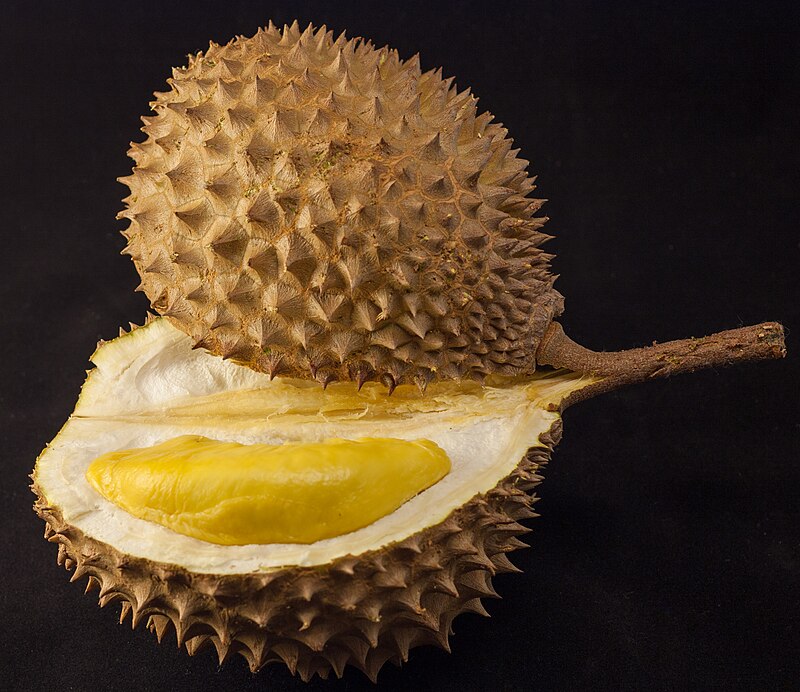
I've not mentioned the durian fruit on our travels.  The durian is both revered and lamented all over southeast Asia.  It's the smell, some think it mellow and pleasant; some think it reminiscent of sewage - which is quite a spectrum of opinion.  Either way, we have seen signs like this everywhere in SE Asia on public transport and in hotels:

There is no fine for durians; only immediate execution.
"I mock thee and thy weak gods"
I only mention them as we found these durian pastry delicacies:


The lady in the shop very strictly ordered us: "You eat in one go; no biting!". So we were told.  This proved tricky for Chan as she does not have my gargantuan head and Anaconda ability to dislocate my jaw to devour larger prey.  Here are the reaction shots:


She says she was burping durian burps for ages


If I were to describe it as anything, it would be a sweet onion and custard taste.  So not devastatingly weird, but weird enough for me to not want another while the taste were still a memory.  

We took tours of both a preserved Baba Nyonya (more on them in a bit) Chinese townhouse and a 17th century Portuguese shop building, which was nice. Although in the case of the latter, I was more impressed by the standard of the wiring that the renovators had put in.  It brought a tear to the eye.

Fun features were spy holes in the floors from upstairs so the mistress of the house could spy om her husband


That's art, that is.
And then, because it was there, we took a boat up the river and back.


The monorail shown below was working intermittently for all the two months after it opened in 2010. After that they apparently binned it as too much effort when it kept breaking down. You'd think it'd be better to fix it rather than have it sit there as a monument to institutional failure. But that's me. Apparently there are rumours of it moving around at night, so either they are surreptitiously trying to get it started again or they have engineer vampires.  Holy shit, I should pitch that to HBO.


The Pirate Park is a fairground on the riverside which reminded me of nothing so much as the Scooby Doo villain hideout aesthetic of Barry Island.


Next stop was a hotel in the tea-growing Cameron Highlands, but we went there by way of the Batu Caves, which has the second largest standing Hindu statue in the world and -more specifically- the largest statue of Lord Murugan, a Hindu Deity.

Well, it's a change of scenery from all the Buddhas.


Outside it were nowt but monkeys, who were obviously used to being fed by tourists, and there were plenty of vendors standing by to sell peanuts for them.  We must've been traveling for a while because this doesn't feel odd anymore.


After leaving there, we made our way to the Cameron Highlands, which offer a slightly more civilised, elevated climate which tops out at about 23°C. It also lacks large mammals and so also lacks mosquitoes and leeches - which is no small selling point.


It's the heart of Malaysia's tea industry and so -having done the coffee plantation thing- Chan obliged me to take us to a couple of the local tea plantations owned by "BOH" tea.  The company was started by a Brit, whose family still runs it to this day, but why he called it BOH remains to be explained. We took a tour of their factory while we were there, because I likes me some plant.


The plantations themselves are quite scenic, although working on them makes for another job I don't want.   They also grow ridiculous amounts of strawberries around here, as the climate is more suited, but they are a bit naff and tasteless.  


Otherwise there was tea drinking with varying levels of enthusiasm as tea is bollocks:


The hotel organised a local trek around the area, which was pretty.  When I asked whether the occupants of the many cobwebs highlighted by the early morning dew were venomous, our guide chuckled: "Oh yes.".  Super.


"Hi there!"


Back at the hotel we had an obligatory Afternoon Tea. I am still indifferent to small cakes and sandwiches, but I guess I'm still just a savage. And tea is still rubbish.

The boss like it though
On the drive to Penang we stopped in Ipoh for some of the local speciality white coffee (as I was jonesing hard by this point).  A local landmark is the Birch Memorial Tower, named for the first First Resident (a kind of governor in this colony's varied past) who was murdered by locals for his "disregard of local custom" - which in this case was slavery.  Yeah, what a prick.  The British authorities hanged the most directly involved miscreants and buggered the local sultan off into exile, installing a compliant rival in his stead.  The Malays ended up naming the street this clock lives on after his assassin, as he is considered a nationalist hero and Birch is considered arrogant and insensitive to local sensibility.  


The clock tower features paintings of 48 historically important people, which, in a sterling example of cultural sensitivity, features Mohammed on the side that faces the neighbouring mosque.  So that was painted over eventually.

Pictured: diplomacy 


The next stop was Georgetown on Penang Island.  Penang was the first foothold in the area of the British Empire by way of Captain Francis Light of the East India Company.  It is a jungle of old and disparate architecture from a myriad of colonial and cultural influences.


We went into the County Museum, so I could marvel at just how subjective a museum can be.  It has exhibits detailing the cultures, clothes and accoutrements of the three main ethnic groups: Malay, Chinese and Indian.  There are also the Baba Nyonya people: the result of Chinese men intermarrying with Malay women resulting in a distinct and proud heritage.

Yeah, exactly the same, guys.

A very well made opium bed.  Apparently the bottom dropped out of that market.


There is also a lack of non-Caucasian mannequins, apparently.
Outside there is the Rolls Royce in which the High Commissioner Sir Henry Gurney was shot to death in 1951 by terrorists, during one of the country's various periods of upset.  The car was used until after independence, when it was replaced by a Cadillac.  Tsk.


There was a mummy cat and her kittens living under it.  Those guys know quality when they see it.


We made sure to catch the tour of the Blue Mansion, which was commissioned by Cheong Fatt Tze, a Hakka merchant-trader who left China as a penniless teenager and eventually established a vast financial empire throughout east Asia.  They called him "The Rockefeller of the East" as he established the first trade routes from China to the young U.S.A and was instrumental in economic policy during the last Chinese emperor''s reign (hence his other common title: "The Last Mandarin")
and also in the short-lived Chinese republic.


The house is an impressive mixture of traditional Chinese architecture mixed in with whatever the hell he felt like.  While the guttering and drainage system retains rainwater for the maximum amount of time under the house before it is drained away (from Feng Shui - Water symbolising money and rainwater symbolising "money from heaven"), the ironwork is Scotland's finest.


The family weren't allowed to sell the house until Cheong Fatt Tze's eldest son died, and while the stripend allowed them in his will -$350 per month- was comfortable money in pre-independence Straights Dollars, when it was changed to 350 Malaysian ringgit after independence it was worth next to bugger-all.  Not being able to sell the place,  they rented it out illegally to 38 (!) concurrent families who made a bit of a mess.  The present owners are conservation architects who bought the place when the eldest son finally died.  They fixed it up to as close to authentic as possible and opened it as a boutique hotel.  It's quite something.


For an animal interlude: here's a crow eating a mango and a cat responding dramatically to heat and humidity.


The street art is famous, if tricky to photograph because every Chinese tourist in creation thinks each photo op desperately needs the addition of their gurning fucking mug.  I haven't kicked anyone over yet, but the day is coming.


We also drove up to the Tropical Spice Garden - an opportunity to see the plants from which many of the spices we use come from, as well as gleaning some dubious insight into their application in "traditional" medicine.  Short version: apparently everything is good for dysentery and fever.  Oh, and the local mosquitoes are really friendly too.


When we were done there, we were determined to get up the Penang Hill funicular railway, which involved Google Maps navigating us through as many spooky Chinese graveyards as physically possible before we realised it was sending us to the top of the hill - which kind of defeated the point.


So we drove back down, used ChanNav instead and caught one of the last trains up.  We stayed up there until sunset, so we could both enjoy the view and wait for the impenetrable wall of home-time traffic to dissipate.


We flew down to Kuala Lumpur for a couple of days in the capital. These isn't a fantastic amount to do there beyond the shopping, but what shopping there is is ridiculous.


We made sure to visit Hutong @ Lot 10, a subterranean food court created by a local entrepreneur by inviting street hawkers of a certain renown and quality to open franchises at his place.  It's all the bounty and none of the botulism.  I didn't fancy the pig's intestine porridge, however:


For some reason, a load of Lamborghinis rocked up outside a neighbouring mall.  Whether this was planned or just a flamboyant bit of showboating is beyond me.


The thing to do, other than shop, is to catch a glimpse of the Petronas Twin Towers from the Trader's hotel Skybar.  They were doing 10 ringgit margaritas. Hurrah.


Here's the tarted-up Instagram version:


Just before we left Malaysia, we visited the national museum.  I found it a bit infuriating as the exhibits read as though they had been curated by politicians.  I was quite looking forward to reading the Malaysian perspective on the split with Singapore, since we'd only heard that from the other side. They only briefly mention some guff about the government of the time 'grudgingly' resorting to Singapore's expulsion from the federation in order to prevent further loss of life during the ongoing race-riots of the time.


The actual bone of contention was Article 153 of the Malaysian constitution, which essentially marks the Malays as the superior race, with quotas given for civil service jobs, special scholarships and bursaries for education, mandated lower property prices, and generally a rather pathetic opinion of themselves.  It is actually against the law to debate the article, even in parliament - where parliamentary privilege would normally allow discussion of anything.   The Singaporeans pointed out how blatantly unfair it was and were kicked out for their sins.


The Malayans' problem, as they see it, was that although they make up 51% of the population, they accounted for only 8% of the national wealth.  The Indians and Chinese are resented for being brought in by the British for their skills -both practical and artisanal- with the mines and plantations. The Malays were almost entirely unskilled by comparisons and remained the peasant class, while foreigners (despite some being there centuries) became the middle, mercantile class.  One thing the museum did point out was that while the Indians and Chinese were building and attending schools, the Malays had to be enticed into class by spending half the day reading scripture.

They do do a good Kris knife, though.
Even though they have increased the proportion of the country's wealth in Malay hands, there is no provision for which Malays received it, with the predictable result is now there is a substantial divide between the rich and poor within Malays, and especially in and around KL.  So while there are Lambos paraded up and down the high street, the corners of that street are marked by heavily-armed security.  Singapore by comparison boasts vanishingly low crime and 90% home ownership, regardless of race.  Just saying.

I'll get back off this soapbox now.  Take a look at this model of a tin dredger.

i.e it dredged tin from the river bed; not a dredger made from tin. 

And seriously, they need to address this Asian mannequin shortage; these look like extras from a 70's sitcom of dubious political correctness:

The one on the right looks like Spike Milligan