
 |
| Mere words can't convey my excitement |

Coming out of KL, we drove south to Malacca. Historically significant as the seat of the Malaccan Sultanate, a vital port and home to various foreign colonial prodnoses, these days it's heavily focused on tourism and so is one of the places one can easily find a drink in this broadly Islamic country.


The mode of transport particular to this area is the trishaw - a pedal-powered tricycle with the passengers sat out front as a human shield. They are apparently decorated by 7 year-olds on meth and traditionally sport ridiculously over-taxed sound systems so that they can boom out shit music as they trundle by. What? Get off my lawn.


We ambled over to Jonker Walk - the Chinatown district of Malacca. It was still wearing the monkey ornamentation of new year while we were there and it bustled with all manner of enterprise, tourist-based or no. Some of its buildings date back to the 17th century, showing signs of both Portuguese and British colonial influence.

This street offers the very best of China; we found jewels like these brazen copies of Lego:
 |
| How many trademarks can you infringe in one go? All of them, that's how many. |
 |
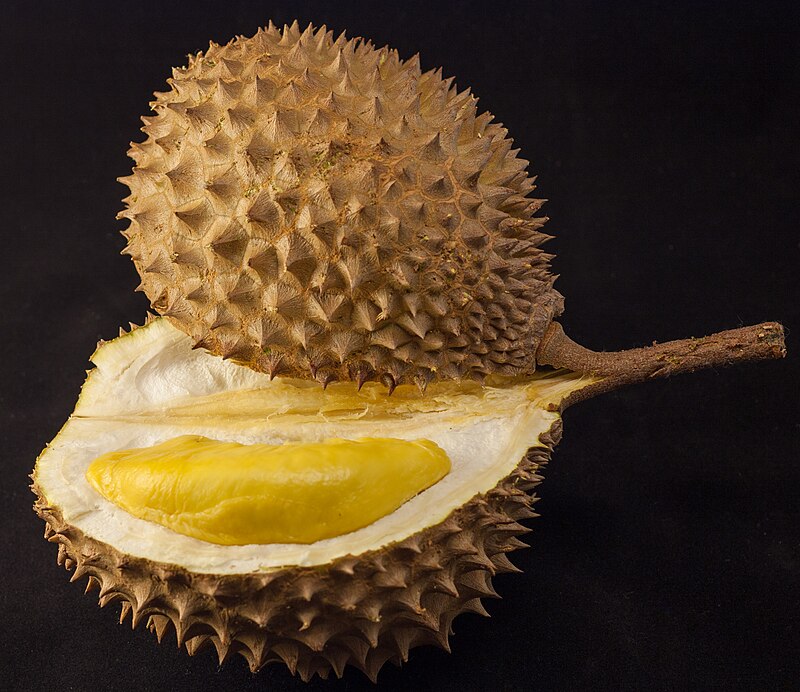
| There is no fine for durians; only immediate execution. |
 |
| "I mock thee and thy weak gods" |

The lady in the shop very strictly ordered us: "You eat in one go; no biting!". So we were told. This proved tricky for Chan as she does not have my gargantuan head and Anaconda ability to dislocate my jaw to devour larger prey. Here are the reaction shots:

 |
| She says she was burping durian burps for ages |

If I were to describe it as anything, it would be a sweet onion and custard taste. So not devastatingly weird, but weird enough for me to not want another while the taste were still a memory.
We took tours of both a preserved Baba Nyonya (more on them in a bit) Chinese townhouse and a 17th century Portuguese shop building, which was nice. Although in the case of the latter, I was more impressed by the standard of the wiring that the renovators had put in. It brought a tear to the eye.
 |
| Fun features were spy holes in the floors from upstairs so the mistress of the house could spy om her husband |

 |
| That's art, that is. |


The monorail shown below was working intermittently for all the two months after it opened in 2010. After that they apparently binned it as too much effort when it kept breaking down. You'd think it'd be better to fix it rather than have it sit there as a monument to institutional failure. But that's me. Apparently there are rumours of it moving around at night, so either they are surreptitiously trying to get it started again or they have engineer vampires. Holy shit, I should pitch that to HBO.

The Pirate Park is a fairground on the riverside which reminded me of nothing so much as the Scooby Doo villain hideout aesthetic of Barry Island.

Next stop was a hotel in the tea-growing Cameron Highlands, but we went there by way of the Batu Caves, which has the second largest standing Hindu statue in the world and -more specifically- the largest statue of Lord Murugan, a Hindu Deity.
Well, it's a change of scenery from all the Buddhas.


Outside it were nowt but monkeys, who were obviously used to being fed by tourists, and there were plenty of vendors standing by to sell peanuts for them. We must've been traveling for a while because this doesn't feel odd anymore.


After leaving there, we made our way to the Cameron Highlands, which offer a slightly more civilised, elevated climate which tops out at about 23°C. It also lacks large mammals and so also lacks mosquitoes and leeches - which is no small selling point.

It's the heart of Malaysia's tea industry and so -having done the coffee plantation thing- Chan obliged me to take us to a couple of the local tea plantations owned by "BOH" tea. The company was started by a Brit, whose family still runs it to this day, but why he called it BOH remains to be explained. We took a tour of their factory while we were there, because I likes me some plant.


The plantations themselves are quite scenic, although working on them makes for another job I don't want. They also grow ridiculous amounts of strawberries around here, as the climate is more suited, but they are a bit naff and tasteless.


The hotel organised a local trek around the area, which was pretty. When I asked whether the occupants of the many cobwebs highlighted by the early morning dew were venomous, our guide chuckled: "Oh yes.". Super.

 |
| "Hi there!" |


Back at the hotel we had an obligatory Afternoon Tea. I am still indifferent to small cakes and sandwiches, but I guess I'm still just a savage. And tea is still rubbish.
 |
| The boss like it though |

The clock tower features paintings of 48 historically important people, which, in a sterling example of cultural sensitivity, features Mohammed on the side that faces the neighbouring mosque. So that was painted over eventually.
 |
| Pictured: diplomacy |


The next stop was Georgetown on Penang Island. Penang was the first foothold in the area of the British Empire by way of Captain Francis Light of the East India Company. It is a jungle of old and disparate architecture from a myriad of colonial and cultural influences.

We went into the County Museum, so I could marvel at just how subjective a museum can be. It has exhibits detailing the cultures, clothes and accoutrements of the three main ethnic groups: Malay, Chinese and Indian. There are also the Baba Nyonya people: the result of Chinese men intermarrying with Malay women resulting in a distinct and proud heritage.
 |
| Yeah, exactly the same, guys. |
 |
| A very well made opium bed. Apparently the bottom dropped out of that market. |

 |
| There is also a lack of non-Caucasian mannequins, apparently. |

There was a mummy cat and her kittens living under it. Those guys know quality when they see it.

We made sure to catch the tour of the Blue Mansion, which was commissioned by Cheong Fatt Tze, a Hakka merchant-trader who left China as a penniless teenager and eventually established a vast financial empire throughout east Asia. They called him "The Rockefeller of the East" as he established the first trade routes from China to the young U.S.A and was instrumental in economic policy during the last Chinese emperor''s reign (hence his other common title: "The Last Mandarin")
and also in the short-lived Chinese republic.

The house is an impressive mixture of traditional Chinese architecture mixed in with whatever the hell he felt like. While the guttering and drainage system retains rainwater for the maximum amount of time under the house before it is drained away (from Feng Shui - Water symbolising money and rainwater symbolising "money from heaven"), the ironwork is Scotland's finest.


The family weren't allowed to sell the house until Cheong Fatt Tze's eldest son died, and while the stripend allowed them in his will -$350 per month- was comfortable money in pre-independence Straights Dollars, when it was changed to 350 Malaysian ringgit after independence it was worth next to bugger-all. Not being able to sell the place, they rented it out illegally to 38 (!) concurrent families who made a bit of a mess. The present owners are conservation architects who bought the place when the eldest son finally died. They fixed it up to as close to authentic as possible and opened it as a boutique hotel. It's quite something.


The street art is famous, if tricky to photograph because every Chinese tourist in creation thinks each photo op desperately needs the addition of their gurning fucking mug. I haven't kicked anyone over yet, but the day is coming.


We also drove up to the Tropical Spice Garden - an opportunity to see the plants from which many of the spices we use come from, as well as gleaning some dubious insight into their application in "traditional" medicine. Short version: apparently everything is good for dysentery and fever. Oh, and the local mosquitoes are really friendly too.


When we were done there, we were determined to get up the Penang Hill funicular railway, which involved Google Maps navigating us through as many spooky Chinese graveyards as physically possible before we realised it was sending us to the top of the hill - which kind of defeated the point.

So we drove back down, used ChanNav instead and caught one of the last trains up. We stayed up there until sunset, so we could both enjoy the view and wait for the impenetrable wall of home-time traffic to dissipate.


We flew down to Kuala Lumpur for a couple of days in the capital. These isn't a fantastic amount to do there beyond the shopping, but what shopping there is is ridiculous.

We made sure to visit Hutong @ Lot 10, a subterranean food court created by a local entrepreneur by inviting street hawkers of a certain renown and quality to open franchises at his place. It's all the bounty and none of the botulism. I didn't fancy the pig's intestine porridge, however:

For some reason, a load of Lamborghinis rocked up outside a neighbouring mall. Whether this was planned or just a flamboyant bit of showboating is beyond me.

The thing to do, other than shop, is to catch a glimpse of the Petronas Twin Towers from the Trader's hotel Skybar. They were doing 10 ringgit margaritas. Hurrah.

Here's the tarted-up Instagram version:


The actual bone of contention was Article 153 of the Malaysian constitution, which essentially marks the Malays as the superior race, with quotas given for civil service jobs, special scholarships and bursaries for education, mandated lower property prices, and generally a rather pathetic opinion of themselves. It is actually against the law to debate the article, even in parliament - where parliamentary privilege would normally allow discussion of anything. The Singaporeans pointed out how blatantly unfair it was and were kicked out for their sins.

The Malayans' problem, as they see it, was that although they make up 51% of the population, they accounted for only 8% of the national wealth. The Indians and Chinese are resented for being brought in by the British for their skills -both practical and artisanal- with the mines and plantations. The Malays were almost entirely unskilled by comparisons and remained the peasant class, while foreigners (despite some being there centuries) became the middle, mercantile class. One thing the museum did point out was that while the Indians and Chinese were building and attending schools, the Malays had to be enticed into class by spending half the day reading scripture.
 |
| They do do a good Kris knife, though. |
I'll get back off this soapbox now. Take a look at this model of a tin dredger.
 |
| i.e it dredged tin from the river bed; not a dredger made from tin. |
And seriously, they need to address this Asian mannequin shortage; these look like extras from a 70's sitcom of dubious political correctness:
 |
| The one on the right looks like Spike Milligan |
