Where are we now?

Where are we now?

Thursday, 25 February 2016

Land of the Thunder Dragon - Part 2


We spent the next couple of days in Thimphu, the Bhutanese capital.  It bustles by Bhutan standards, as more and more younger Bhutanese move here to get jobs that don't involve field-based toil. The first thing we did was drive up to the Buddha Dordenma statue, a 169 ft colossus - the largest sitting Buddha in the world- which peers down on the city.  All of the funding for this came from a donor in Singapore, so no public money wasted. It's a good view up there too.


We went inside the statue, as it is also a temple, and saw about fifty young monks chanting scripture communally. None of the monks or nuns we met on the trip mind staring openly at the curious foreigners, especially if they have green hair.  Let's have a look at that Burmese hat again.

A slightly mad old man in one of the dzongs thought it was a cat. 
Looking down, you can see what passes for sprawl here on the city.  If you look at the picture, the large building is a dzong, the second largest is a government building, and if you look closely on the middle-right of the photo you'll see the royal palace.  A modest building by palace standards, it reflects the kings' wishes that public money is not spent unnecessarily.   It was the fifth king's birthday while we were there (and his wife had just given birth to king number six the week before), and while there are celebrations aplenty across the country, the king made sure that fuss (and cost) was minimal.


We were then taken to Motithang Takin Preserve, which has a slightly amusing history.  It was once a zoo, built by the third king to house examples of all of Bhutan's native animals, only to be closed by his wife after his death as she deemed it not very Bhutanese to keep animals caged up. The animals were set free and most of them buggered off.  Unfortunately the Takin were a bit too domesticated by this point and took to hanging around the streets, hassling people for food.  So it was decided to round them all back up again for their own good.  In case you've not already googled it: The Takin is the national animal of Bhutan (it used to be the yak, but they binned that because it is boring).  It is a type of local goat-antelope said to have been created by Drukpa Kunley - the "Divine Madman" - by gluing together the head of a goat with the body of a cow. We'll get back to Mr Kunley later, for he is both very culturally significant and possibly the only reason I would find religion.

I'm sure there is a perfectly good explanation for this scene
An American lady was cooing over the Takin in the park, enthusing that they were "beautiful animals". They categorically are not; they look like avant-garde taxidermy.

"What am I?"
We went down to the city proper, to have a look around.  In case you hadn't realised, Bhutan is rather a religious place. You will not go far without seeing prayer flags strung up along the roadsides and across rivers and bridges; prayer wheels (to be turned clockwise) adorn the outsides of many buildings, being turned by hand, flowing water or the wind; stupas (structures containing relics, which are sites of meditation), adorn roundabouts, children's play parks and rice fields alike. Before making important decisions, be they business or personal, it is common to go to a temple and have a monk and lama roll dice to look for auspicious numbers to decide on the outcome.  When the king or the government commissions a large construction project, it will not start until a date which is astrologically favourable.  Things generally make more sense if you have a vague grounding in Buddhism before you arrive.  Personally, I had no idea what was going on and just followed our guide's lead in a fog of bemusement.


In the middle of the city there is the Memorial Chorten (a local word for stupa), dedicated to the memory of the third king.  We joined in with the procession as it walked (again: clockwise) around the stupa, which was actually quite relaxing.


This particular stupa is where one goes to pray for ill relatives.  Some of the prayers translate a little oddly though:
Indeed.
We were then taken to the local paper factory, where they hand-make the paper used for religious texts out of the local daphne bush. It's a diverting ten minutes and it's always good to see good craftspeople going about their work.


And obviously one of the staff is a Man United fan:


We were then set loose in town for a bit for a mooch around.  I haven't mentioned the national dress: the goh for the men and kira for the ladies.  The goh is a knee-lengh robe tied around the middle; the kira is an ankle-length dress, also tied around the middle.  It's required wearing for certain jobs and occasions, but people seem to wear it most of the time anyway.  It's part of their national identity and so they embrace it. It also keeps the Himalayan breeze out, which can't harm its popularity.  It's actually quite fetching.


None can resist the might of Frozen
One of the more photographed sights of Thimphu are the traffic police in the middle of town.  They did actually try introducing traffic lights, but the locals rejected them as impersonal and insisted on the blokes with the white gloves.


While there are shops which sell odds and ends, there are no supermarkets to speak of, so most of the weekly shop is done at the market.  Here farmers and traders ply their wares in a vast purpose-built sheltered concrete structure.


They sold chillies in quantities that whole towns wouldn't use in a year in the UK.

That takes care of Sunday lunch.
Before we left town, we were shown around the 'Simply Bhutan' living museum, where they've set up a compound with a traditional farmhouse and demonstrations of other aspects of rural Bhutan that they are worried are being lost as more kids flock to the city, despite 60% of the population living like that for real. Anyhow, they dressed us up in the garb:

I can think of no practical purpose for that hat; it barely covered my ears.
This is more indicative of my head than that hat though.
The importance of the phallus as a symbol of power and fertility was explained to us with a deadly serious face. It is tradition that new building have woodern penises hung from each external corner. Apparently the ceremony involved in placing said dongs on the roof generally results in everyone getting drunk.  Once again, this is attributed to Drukpa Kunley and his willy waving ways. I'll talk all about him when we get to Punakha, I promise.

Ah, an excellent harvest of cocks this year, it seems
On the way into the museum we were given the traditional greeting cup of ara  - a type of rice wine that is not unlike sake. It is made at home using a crude distillation process with fermented rice and a pressure-cooker type arrangement.  It's not completely unpleasant but I'll stick to the bottle of Druk11000 in a paper bag, thanks.


The picture above is your classic Bhutanese wood-burning stove, which has no chimney so it's a bit smokey.  Which reminds me: I don't think I was away from the smell of smoke during the entire week -there was a forest fire near Paro which was still burning when we flew out again; the temples and Dzongs are perpetually burning some kind of odd incense and cypress wood; and everyone else is making hooch in their kitchen on their log burners.

Here you see traditional Bhutanese ingredients consisting of chillies and not much else.


The national sport of Bhutan is archery, which they are somewhat fanatical about.  I got a chance to show johnny foreigner how we do things in the old kingdom and proceeded to demonstrate that I could not hit a cows arse with a banjo.  Chan did somewhat better in that she did at least hit a target, even if it was the wrong one.


This cheerful chap, Pema Tshering, has cerebral palsy and a spine defect and so can't use his arms. He was found by the Queen Mother in a village in the remote east and she brought him back to the capital to be trained-up by her charity after she's seen how he'd managed to carve a bow and arrow. He learned to paint and then to carve in the traditional woodworking fashion of Bhutan and now runs a workshop in the museum, selling quite exceptional carvings and paintings.


We also tried butter tea.  This is tea made by steeping tea leaves until the water turns black, before being strained and churned with butter and salt.  It is then sometimes served with popped rice.  It tastes somewhat savoury but not entirely unpleasant.


Chan told me that she didn't mind the tea so much as the rice floating around in it.  But then she doesn't like milk on breakfast cereal so her opinion is void.

To be continued.

Monday, 22 February 2016

Land of the Thunder Dragon - Part 1

We're back in Thailand after eight days in Bhutan.  I'm going to break this up a bit so that I don't forget anything.  So here's some preamble and the first day.


So last time I wrote we were leaving Thailand. Druk Air is the main airline to get you to Paro - the only international airport in Bhutan.  Druk is the state-owned carrier, with a fleet of four Airbus 319s and an ATR twin prop. They have a habit of delaying/cancelling flights as the fog over Paro makes an already treacherous run (there are only eight pilots certified to land there) unacceptable.  They also bugger off early without warning for similar reasons. This is not good for my nerves.

"Hey, we've got a schedule to fabricate"
Bhutan is a geographically isolated kingdom in the Himalayas, with ethnic, religious and historic associations with Tibet.  A small country of approx 750,000 people, it has come into modernisation relatively recently.  Indeed, foreigners were not allowed in until the latter half of the twentieth century and it is still relatively unknown as a travel destination.  Chan only heard about it when reading an article in one of her (many) travel magazines a couple of years ago.  I have to admit, there was an attention-seeking attraction to being the only people we know who’ve been there.


Bit of history for you:
After several centuries of your typical-for-the-region-and-time-period tribal, religious and imperial upheaval, the present dynasty of the Druk Gyalpo (Dragon King) was established in 1907.  Sir Ugyen Wangchuck (a Knight-Commander of the Indian Empire due to some complicated bit of British imperial malarkey prior to this) was elected as hereditary king of Bhutan by the senior chiefs and lamas of the day.  The first two kings maintained decent relations with Britain and India in light of Chinese interference in Tibet.  They also managed to dodge most of the awfulness of the depression and both wars due to the country’s isolation and barter economy.


The third of the Druk line, Jigme Dorji Wangchuck –the “father of modern Bhutan”- was a particularly progressive character who solidified their relations with India after the Chinese invasion of Tibet and set about implementing wide-scale development of the country by building schools and hospitals, reforming taxation and improving administration.  His son, the fourth king, who succeeded when he was only 16, established the policy of  Gross National Happiness – taking the country not necessarily down the path of maximum economic growth, but by establishing policy geared towards what he deemed to be the country’s maximum long-term well-being while maintaining the environment and the country's spiritual and cultural identity.  That's the plan and it seems to be following through - as far as can be measured, people are genuinely happy and their lives are improving.


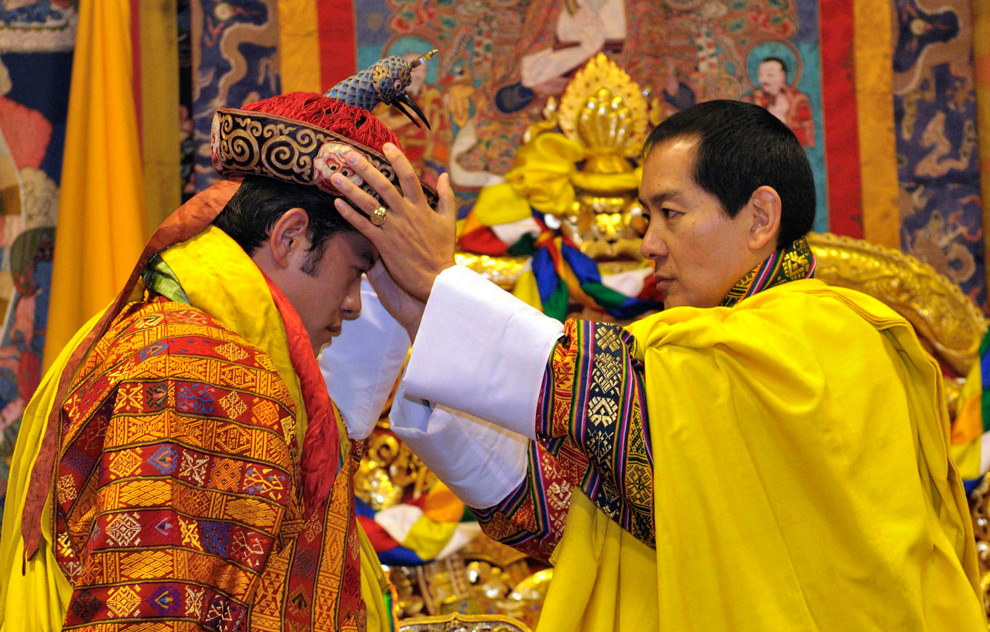
He shocked the nation in 2006 by both abdicating in favour of his eldest son, and by announcing the establishment of a new democratic parliamentary system and constitution.  The king coronating another king with the Raven crown is described as 'unprecedented' in the various texts on the subject. Personally I think just about everything is a precedent when there's only been four of you so far.
King number 4 is still alive (and only in his sixties) and acts in an advisory capacity to his son, and between them they have established comprehensive education, healthcare and investment that has brought Bhutan, while still poor and with limited resources, into the 21st century.  It is no overstatement to say that he royal family are adored, which is understandable because I've only been here a week and I quite like them too.


Which brings us to now.  Tourism in Bhutan is controlled on an “High Value; Low Impact” basis, where they regulate the industry by imposing a high daily tariff on tourists (US$200-$250 per person, per day) from which the government skims $65 to pay for Bhutan’s various projects, and for which the tourist gets a driver, a guide, all accommodation and all meals.  Unless you’re Indian or are working here in some capacity, this is the only way in.  You can tailor your trip as you like and a tour firm will sort it for you, but you’re not allowed to come in without a guide.  An interesting feature is that all fees are paid up-front to one of the Bhutanese government’s various international bank accounts, and the tour firm is not paid until the trip is satisfactorily concluded.  Got to be the only government I've actually trusted with my money.


So we arrived in Paro and were met by our guide, Tshultrim, and our driver, Raj.


These guys would be taking care of us for the week.  The state trains up all of the tourist staff in the country, so the guides' English and knowledge is excellent, if Tshultrim is any indication.  Raj spoke more English than he let on, I think, as he was always smiling but quiet. His main job was to ferry us around the country on roads described by Lonely Planet as 'harrowing'.  I dunno about that - we've seen roads in poorer states of repair in Argentina, and traffic in Bangkok which is several shades more demented.   But safe to say, the highways become rather idiosyncratic as you leave town, and it's best to have someone local at the wheel.


First thing we did was see the Rinpu dzong and the national museum, which are adjacent to one another.  We would see several dzongs - a combination of monastery and fortress- before we left. Historically they formed the fortification of the nation, and are dotted all over the country on strategic hillsides and boundaries.  Today they are half monastery and half local government administration centre.  Rinpu Dzong dates from the 15th century and is in remarkable nick.  This is a feature we'd find about all local architecture: it's made to last.  even the more modest farmhouses were and are built the same way - with big bits of wood.


Butanese (Dzongkha) uses the Tibetan alphabet, which looks like Klingon.
We went around the national museum and were introduced to several of the local customs and celebrations, including the large festivals hosted in each town at various times of the year.  We caught one such event later on in Punakha, which I'll talk about on the next post.


We continued to lunch, which was organised by the tour firm at a local restaurant.  Bhutanese food is mainly the local (red) rice, vegetables in various forms, some manner of meat, and chillies.  They eat chillies as a vegetable on their own.  When we first heard of the national dish, Ema Datse (described as chilli-cheese in the literature), we imagined it as cheese with chilli in. Nope. It's a pile of chillies with cheese on. Accordingly, traditional Bhutanese cuisine is often a mouthful of pain.  

I quite liked it
What the tourists get is substantially less exciting than what the guides eat. Because they catered firstly to Americans when the country opened for tourism, and now more often to vast swathes of Chinese, the food is somewhat bland in order to offends the fewest palettes. It's nice enough, and all fresh local produce (aside from the meat which is shipped frozen from Thailand and India - they don't kill anything in Bhutan), but we had essentially the same meal 16 times, regardless of where we were. Breakfast was often a glorious mess: eggs featured, but then often so did fried rice, chow mein and congee.  One morning I had egg and chips (fries to the 'Merkins in the audience) with fried rice.  I'm not fussy.


On the drinks front, you can buy three beers in Bhutan.  Red Panda is a Weißbier made by a Swiss immigrant who the King coaxed over to make cheese in Bumthang.  He made some beer while he was at it.  The other two are made by the imaginatively-named Bhutan Brewery and consist of: Druk Lager, which is a fairly generic lager but is drinkable enough; and Druk 11000 which is 8% by volume (which would safely categorise it as "Tramp Bait" back home) and is a much more interesting animal.  It was rather moreish and only about £1.50 for half a litre. I became somewhat partial to that at mealtimes.

The eagle-eyed will note that two of the bottles above are re-used Indian Kingfisher bottles, as they have no bottle-making facilities here.  So the shape and colour of your beer bottle will often change day-to-day.

So after lunch and after a reasonably short drive, we stayed in the capital, Thimphu, for the night.


To be continued.