
Following on from the Siem Reap post, here is the glorified photodump of our explorations of the Angkor temples. For those of you who don't know, Angkor was the capital city of the Khmer Empire, which was in charge around these parts from the 5th to the 15th centuries. The remnants of the city represent a pan-generational god-king willy-waving contest, where successive monarchs attempted to up the ante with each additional structure.

Angkor is meant to be a representation of Mount Meru - the Hindu equivalent of Mount Olympus - indeed the stone structures remaining would be meant for housing deities, as men and kings had to live in wooden structures, with stone and brick structures reserved for the gods. I hope they kept the noise down.

The greatest achievement was Angkor Wat - the world's largest religious monument. It is contemporary to Westminister Abbey (i.e built in the 12th century), but while the population of London at the time was about 50,000, here it was over a million. It survived pretty well into the twentieth century, suffering minimal damage during the various Khmer Rouge-Vietnam-US-related conflicts. Then, during the 80s and 90s, thieves operating out of Thailand lopped off every statue head that could be had, which is irksome.

We visited twice during our time in Siem Reap: once just to amble around in the middle of the morning and once at arrgh o'clock to catch sunrise along with half of known civilisation. Angkor Wat faces west, which is unusual for a Hindu temple as that is the direction associated with death. Competing theories for this morbid design decision are that the temple was devoted to Vishnu (who's in charge of the west) or that it was designed to be a mausoleum for its creator, Suryavarman II. Either way, it means the sun rises behind it, and every selfie-stick owning gawper and his dog turn up for sunrise. There was a fair bit of cloud cover when we came, so we'd struggle to make a convincing argument for seeing it over four hours more in bed.

The bas-relief stories on the inside of the outer-most walls serve as a kind of Bayeux tapestry of the period, detailing several epic battles, the churning of the sea of milk (which features a few times in the temple complex) and a gratuitous illustration of judgement of the recently deceased by the lord Rama. He's a cuddly looking gent with multiple club-wielding arms who decides which of the hells you're going to, sinner.

One funny thing we did witness was a group of Chinese retirees who, overjoyed to see a white toddler (many mainland Chinese don't see white people, much less western kids), promptly picked him up and passed him around for photos. The tot wasn't bothered, and his parents were apparently used to this by now because they left them to it.


You enter by way of one of four cardinal point gateways, each reached by a stone bridge lined by 54 gods and 54 demons, engaged in a galactic tug-of-war using the body of the Serpent King, Vasuki. The astral beings are using said reptile to churn the sea of milk -the waters of creation- from which they were trying to extract Amrita, the drinking of which makes one immortal.
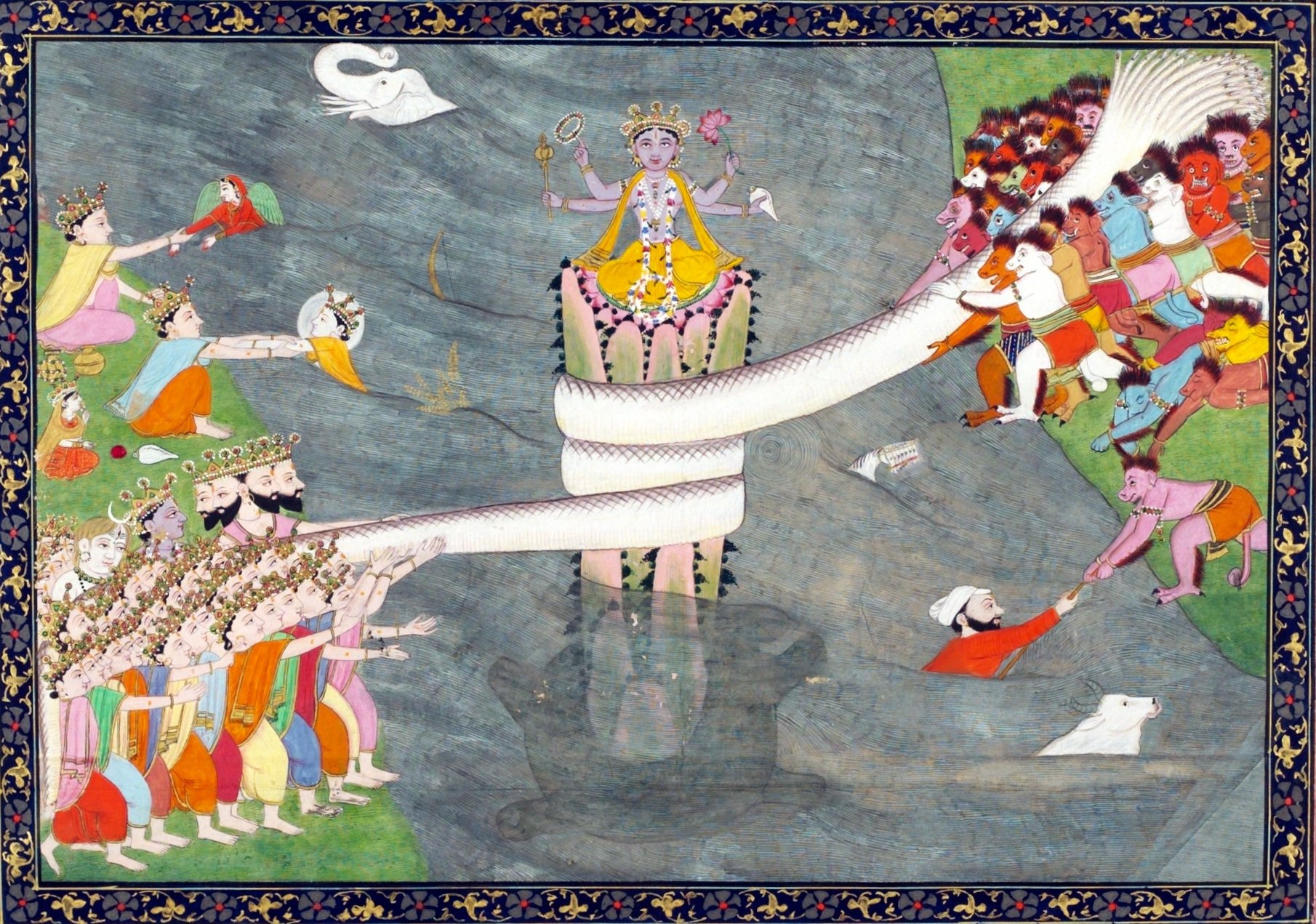 |
| Vishnu was umpire |


The biggest structure within is Bayon, which is as magnificent as it is bizarre to behold. By this point the Khmer king was a Buddhist, so it's arranged a bit differently to Angkor Wat. It's arranged somewhat at odds with sanity, to be honest. It consisted of 59 towers, bedecked with 216 vast smiling faces of Avalokiteśvara (which represents the compassion of Buddha). Less charitable archaeologists have noted a suspicious similarity to the king that built it though. The king in question, Jayavarman VII, was a prolific builder of hospitals and public works, was wildly popular and largely considered the greatest Khmer king of all time. I guess he gets a pass on the egotism.
 |
| Artist's representation. The eyes. |


Nearby is Baphuon - a pyramidal structure that was in the process of a protracted restoration project. It has been drawn-out because the French experts working on it in the early 20th century had to leave due to the various wars, and the Khmer Rouge destroyed all plans and records related to the structure because there was no single way in which they were not thorough dickheads.


North of there is Phimeanakas - another three-tier pyramid, about which I know very little, save the desire to climb it and do battle with the video game boss that surely lives at its summit.

The Terrace of the Elephants was the base of the King's audience hall, and looks down on to the parade ground. It was originally part of the palace of Phimeanakas (the one above for the spectacularly low of attention) and was used by the king to inspect his returning victorious troops as they marched by. I'm going to guess it also involved elephants.


The Terrace of the Leper King is adjacent and, rather disappointingly, probably didn't involve any monarchs with leprosy. It was named for a nearby statue, nude but featureless, which had a tendancy to grow moss. It is theorised that the statue represents that friendly Lord Rama again. Since he is the king of death (awesome band name, by the way), the facility was likely the royal crematorium. Some of the carvings look like they were done yesterday, rather than 600 years ago.


On another day (don't ask me which; sorting these photos has rendered me simple) we got up early and Sok drove us an hour out of town to Banteay Srei. If the rest of Angkor is a museum, this is the art gallery. The buildings here are hewn from pinkish sandstone and are much smaller in stature than those in other sites. The intricate carvings and the buildings' miniture scale have likely given the site its name - which means "Citadel of Ladies" - as the carvings are deemed too fine for a man's hand.


Whereas the likes of Angkor Wat and Angkor Thom have been, if not in constant use, in some manner of regular interaction, Ta Phrom was abandoned to the jungle. It is a similar age to the other temple complexes, but the irrepressible local flora have had their way with it.


This is real Indiana Jones territory - in fact, one of the Tomb Raider films was shot here. Sok described it to us as "The jungle temple; Angelina Jolie movie was there". It's a close system of towers and courtyards, and is claustrophobic enough before the relentless green cuddle of fecundity blots out the light.


The Rolous Group get a bit lost in the photo collection, but were interesting in their own right and are the oldest of the Angkor structures, being circa 9th century.


Preah Khan (which means Sacred Sword - a cool name for a Christian rock band) has a labyrithian layout in which I could get genuinely lost. This is no real achievement as I get lost going to the kitchen to make a sandwich, but it's still a bit of a complicated sprawl. It's also religiously bi-polar as aspects are Hindu and others are Buddhist.


While I was getting myself hopelessly geographically displaced, I managed to stumble into a small dark chamber. It was squeaking.
 |
| "Howdy" |

It's relatively small, and also somewhat abandoned to the elements. The eastern outer gopura is a bit of an attraction in it's own right, as it has been enveloped by a sacred fig tree.


I managed to find the bats here too.
 |
| "We are imminently going to shit all over you." |


This is where they kept the royal mosquitoes.

There are more, but I think that'll do. We're glad we bought the 7-day pass ($60 per person, for those who're interested), as it let us take our time and bail when it got too hot. It's worth a visit. It's the closest you'll get to being an adventurer of old, picking through temples of ancient civilisations.
You and two dozen Chinese with selfie sticks.
Kurzfassung auf Deutsch: Wir besuchten Angkor. Hier kann man sich wie Indiana Jones erkunden.

No comments:
Post a Comment