
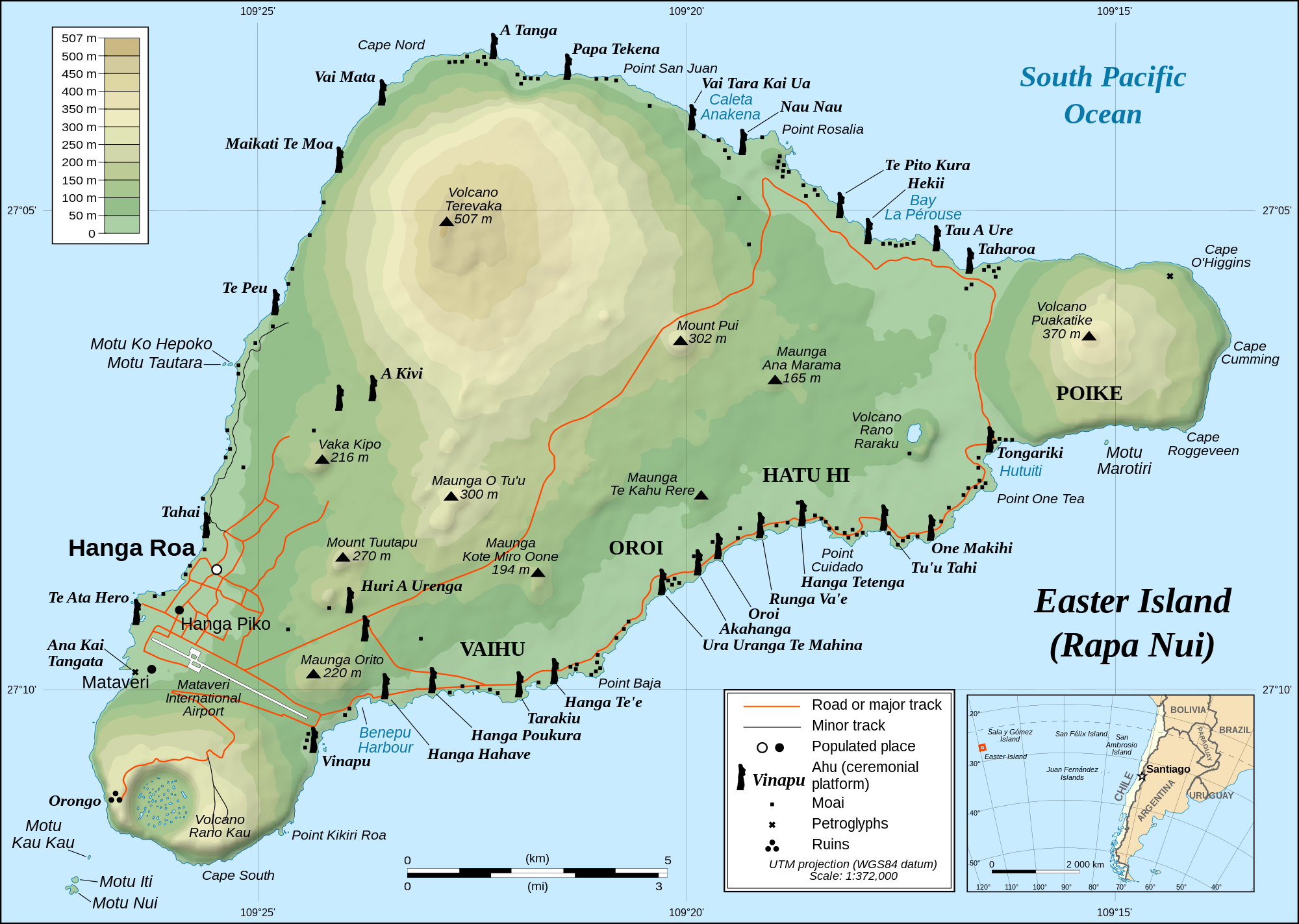
We left Santiago feeling pretty excited as we were heading to the place that we had been travelling towards since the inception of our trip- Easter Island. Most people have heard of the island, some people are familiar with the pictures of mysterious statues but the majority of people probably couldn’t point to it on a map. So we flew on a domestic flight for over 5 hours from the west of mainland Chile, where we landed at the most remote airport on Earth (next airport is 1800km away so the equivalent of flying from Liverpool to Ankara). An island of just 24 km across and with a population of about 5500.

We were greeted by our host, Christophe, who was a vibrant French character who's been on the island about 21 years, running his cabañas. He kept forgetting what language to speak, lapsing between French, Spanish and English - which kept us on our toes.


We got ourselves Gareth's new preferred ride, quad bikes, and headed off to search for the BIG FAT HEADS!

Easter Island was settled by the Polynesians. The legend is that the King Hotu Matu’a was told that his island was going to suffer a catastrophic event, prompting him to send out 7 men to find a land which his shaman had seen in a dream. The men found Easter Island and reported back to the king, who then took his population and relocated to the island. Tradition holds that they landed at Anakena, which is a very beautiful beach. This occurred between 700 and 1100 BC


The heads are called Moai in the language of the islanders, the Rapa Nui. There are many stories suggesting that the population spent all their time and resources building the Moai only to turn on each other when all natural resouces on the island were exhausted, and destroying the other tribes Moai. It is correct that they had chopped down most of the trees but they were good farmers and fisherman and so the lack of trees did not immediately affect their sustenance. However, as time went by they would not have been able to replace larger fishing vessels and the tree-less island would have been more susceptible to erosion. Although life might have become tougher a civil war theory does not appear to have any evidential basis. (Our Guide commented that if pushing over the Moai were acts of war, then surely efforts would have been made to right them) Lacking a written record, many stories and theories about the island outside of the Rapa Nui's own inconsistent verbal history is speculation and hearsay.
 |
| But it does look like someone had a bit of a crisis of faith |
Some time after settling on the island, the Rapa Nui came up with the idea of creating the Moai. Building these statues was not a tradition which already existed in their culture. Moai were created in the form of old Chieftains or other important people. The Rapa Nui used the statues to harness the power of the gods and the power assumed to belong to their deceased chiefs to look after them. Moai were generally placed on a platform that contained the remains of the VIP and were turned inwards so that they could watch over the clans.

A lot of the Moai around the island remain where they were pushed over. It is costly to restore the Moai, particularly given how isolated the island is. I am in two minds about whether they should all be restored: a significant part of the history is the fact that they eventually were pushed over by their creators (for whatever reason), but at the same time -historic temper tantrums to one side- they are all out in the elements which will mean that eventually the Moai will be eroded away to featureless rock to no-one's benefit, so there's an argument for restoring them in place or even removing some to a controlled environment.

By 1868 there are no reports of Moai standing. It is believed that quite simply the locals stopped believing in the power of the Moai and/or became angry with the Moai. This perhaps was prompted by their interactions with outsiders with far greater weapons, technology and prosperity. If the Moai were effective then why had they not provided them with the same things despite the Rapa Nui's total devotion? Why had the Moai not protected them?
 |
| "You guys suck" |

However, when Easter Island ran out of trees, the Moai could
no longer be transported. This didn't stop production, however. The Rapa Nui responsible for the Moai carving were distinct from the transporters, who were distinct from the guys who built the plinths, who were distinct from the heavies who installed the figures in situ, who were distinct from the artisans who made the eyes out of coral, who were distinct from the whole other production system that produced, transported and installed the red 'topknot' decorations out of different rock from another quarry. Orders were still coming in and the production continued, despite the inability to relocate the statues. By the time the islanders fell out of love with the Moai, there were 300+ figures waiting for collection from the quarry.


Although many of these look like they are only heads, all of them are whole body Moais, albeit buried up the shoulders over time by nature.

 |
| "We haven't invented paper" |
Pausing for just a second to reflect on this production line: The tallest Moai was called Paro, who was almost 10 metres tall and weighed 82 tons, and was erected about 8km away. The distance from the quarry to Ahu Tahai (to the north of Hanga Roa, picture below) is about 18km. These people had no cranes, horses or other beasts of burden and yet they transported the Moai these huge distances, on rough and hilly terrain. Actually how they did this remains the subject of much speculation but no one knows the answer, although it is believed that trees were a fundamental part. We were told that they were transported upright, as befits their status, but also to reduce stress on the fragile narrow of the neck.
They were actually in the process of building a 20 metre example, but he was never removed from the quarry wall.
 |
 |
| Middle of the picture, lying on his back. Gareth walked past it twice. |

As I mentioned above, most of the Moai were adorned with a red coloured rock which would represent the “topknot” of the chieftain. These were made in another quarry, a product of a different volcano.


An American archaeologist called William Mulloy was a regular visitor and in the 1960's decided to restore some of the Moai. His intentions were good, but he did just put some random Moai together at Ahu Tahai which don't actually belong there, from different eras - hence the divergent styles.

He also decided to cement the eye sockets of another Moai and paint on the eyes so that everyone could see what they look like. It does add another dimension to the Moai and makes them even more enigmatic. However, half a century later his methods are a bit irritating especially when you think that technology could have replicated the coral eyes accurately by now. There is a tribute to Mr Mulloy in Hanga Roa and from discussions with our guide, it is clear that he is still held in high regard by the Rapa Nui.
 |
| They gave him his hair back, too |

We returned for a second visit later in the day, to get a less dramatic look.

On our final day on the island we booked a group tour but it turned out it was just the guide and the two of us, which was excellent. We had the opportunity to ask our Rapa Nui guide loads of questions. Aside from the conventional academic research into the history and conservation of the island, he's made it his work to glean as much of the oral history as possible by interviewing the island's older generations and comparing their accounts.

As mentioned, we don’t really know why the population fell out of love with their Moai, but when they did they then came up with a new plan to “channel” the gods: the cult of the birdman.
There is a migratory bird, the sooty tern, which nests on an islet off Easter Island. It only lays one egg a year. It was decided to hold an annual competition to collect the first of these eggs to decide the leadership of the island. Tribal chieftains would nominate champions to enter the competition, and the winner's sponsoring chieftain would become the head shed for the following year. Beforehand, all competitors hung out in these huts -kind of an Olympic village- in the weeks prior to the event.

 |
| Cozy |
When the race started they would run/climb/fall down a sheer cliff. I should mention
at this point that attempts to take out your opponents, a la Dick Dasterdly, were
expected, encouraged and allowed until the opponent was in possession of an egg, at which point it was hands off.
So assuming you didn’t fall to your death or run into your opponents fist, you would make it to sea level. Of course you might have a few cuts from your opponents or the rocks but they were inconsequential as it wasn’t like you were going to have to swim 2 km through shark infested waters or anything…..oh.
When they got to the islet they would have to search for the egg, which might take weeks. Once the egg was in your posession your opponents couldn’t attack you, but you still had to swim back and get up the cliff whilst making sure your egg didn’t break. First guy back with an unbroken egg wins. What reward could be worth all of this? Well in addition to the gratitude of your Chief, you would also be given the beautiful virgin that they had stored in a cave in a volcano for the last 3 months. Yes, really.

The people eventually gave up on the birdman as well. This appears to coincide with the majority of islanders (all of them save about 100) being taken away by Peru as slaves. Unfortunately many died in captivity, including their last remaining scribes and historians, hence why Easter Island is such a mystery. There are surviving texts, but no one can read them.
The next visitors were Christian missionaries and Tahitians, who are close relatives of the Rapa Nui. These days, the Islands have now embraced Christianity as they are regular church goers and it seems that not going to Church regularly (read: every day) is very bad. However, I was quite taken aback when we visited the Church as to the influence the islanders' previous religious inclinations have on their Christianity. Figures and symbols reminiscent of the Moai and the Birdman are etched all over the Christian iconography. Lapsed-catholic Gareth counted about 14 different types of heresy.

Our accommodation was superb and the host, Christophe, was top bananas.
Accommodation and flights are expensive on the island but we had some nice meals
and we thought the prices were on par with Santiago. We do keep foolishly
ordering a main meal each, though. The local cerviche could feed four. I also see it as my duty to experience the local culture wherever I go through their national drink. This is still Chile, so it was a pisco sour as an aperitif, starter, to accompany my main and as a dessert.
So assuming you didn’t fall to your death or run into your opponents fist, you would make it to sea level. Of course you might have a few cuts from your opponents or the rocks but they were inconsequential as it wasn’t like you were going to have to swim 2 km through shark infested waters or anything…..oh.
 |
| The one at the back |
When they got to the islet they would have to search for the egg, which might take weeks. Once the egg was in your posession your opponents couldn’t attack you, but you still had to swim back and get up the cliff whilst making sure your egg didn’t break. First guy back with an unbroken egg wins. What reward could be worth all of this? Well in addition to the gratitude of your Chief, you would also be given the beautiful virgin that they had stored in a cave in a volcano for the last 3 months. Yes, really.

The people eventually gave up on the birdman as well. This appears to coincide with the majority of islanders (all of them save about 100) being taken away by Peru as slaves. Unfortunately many died in captivity, including their last remaining scribes and historians, hence why Easter Island is such a mystery. There are surviving texts, but no one can read them.
The next visitors were Christian missionaries and Tahitians, who are close relatives of the Rapa Nui. These days, the Islands have now embraced Christianity as they are regular church goers and it seems that not going to Church regularly (read: every day) is very bad. However, I was quite taken aback when we visited the Church as to the influence the islanders' previous religious inclinations have on their Christianity. Figures and symbols reminiscent of the Moai and the Birdman are etched all over the Christian iconography. Lapsed-catholic Gareth counted about 14 different types of heresy.

 |
| Jesus shown here with the traditional Birdman crown...wait, what? |
 |
| No idolatry here, move along. |

Easter Island is part of Chile but there is a group of Islanders who wish to
be independent. Apparently Chile annexed the Island following a suggestion from...guess who? Yes, Britain, to make sure France didn’t get it. The problem is that
the people thought they were signing a friendship agreement (the document was
only in Spanish) instead they were effectively giving up their sovereignty. In the 20th
century, the government leased the island to a sheep company who basically
stopped the population from going anywhere on the island. It is only relatively
recently that the islanders have felt supported from Chile. In fact it was
Pinochet’s government who was the most progressively supportive, and even now the population of Easter Island remain quite
loyal to him.

The island is very pretty, it is just strange looking out to sea knowing that the next bit of inhabited land is over 2000km away.


Easter Island is now dealing with the double-edged sword of tourism. You are basically able to wander over the whole island. There aren’t any huge barriers preventing you from getting near the Moai, the place relies on people doing the right thing. Unfortunately people can’t really be trusted and you could see the carelessness of people in places through plastic bottles, carving names etc. Visitor numbers were only about 4000 a decade ago and last year 70,000+. There is also the question of the actual value of visitors to the island. It is possible to stay on a campsite for $20 per night. You only have to pay the national park fee if you visit the quarry or the birdman site. You can eat a filling meal for less than $10. Yet the cost, financial and environmental, of visitors- transport, rubbish, electricity use (bearing in mind pretty much everything is imported), travelling to the Moai is far more than this. Additionally, the last few years has also see record numbers of mainland Chileans moving to the island which has had an impact on infrastructure.


Visiting the home of the Big Fat Heads definitely felt like the trip of a lifetime.


